DoECO · Food packaging · Ecommerce SEO
SEO for food packaging manufacturer DoECO
Ecommerce SEO for food packaging manufacturer DoECO: category structure, product content and B2B enquiries. View the original Google and Yandex traffic report.
- Services
- Ecommerce SEO


The brief
Connect professional packaging searches with DoECO’s catalogue and help new buyers identify a suitable product before discussing supply.
Results at a glance
- Search traffic
- ≈ ×1.8
- Visits per month
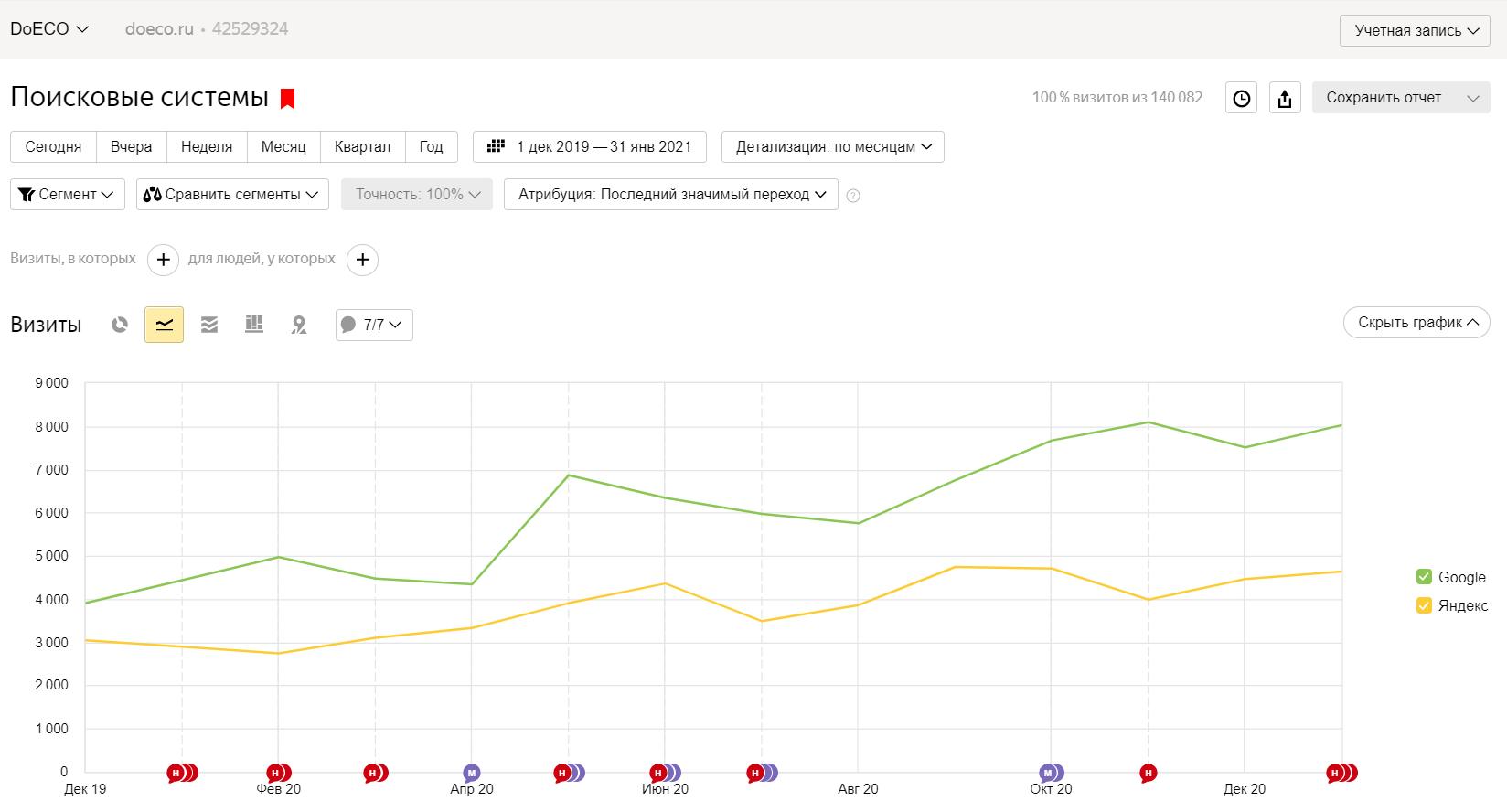
- ≈ 6.9k → 12.7k
Google + Yandex · visits per month, rounded from the chart
From December 2019 to January 2021
- Reporting period
- 2019-12-01 — 2021-01-31
DoECO · Food packaging
The challenge
DoECO supplies food packaging to cafes, restaurants, delivery businesses and food producers. The SEO objective was to reach buyers who knew what they needed to pack, but had not yet chosen a manufacturer or product line. The website had to explain the range in their language and help them prepare a specific supply enquiry.
Where we started
We reviewed the catalogue from two starting points: an existing customer searching for a familiar item and a new buyer searching by use. We then compared categories, product pages and internal links, identifying where a search required a choice of formats and where it required the details of one product. This provided a practical sequence for content and technical work.
Problems we solved
Product-line names did not match how new buyers searched
Before
A buyer could know the dish, portion or delivery format without knowing DoECO’s product names. Brand terminology alone restricted discovery of the range.
What we changed
We grouped demand by use: ready meals, fast food, desserts and wholesale supply, then mapped each group to a category or product page.
Business buyers needed enough detail to compare products
Before
A general claim about convenient packaging did not establish whether an item suited a buyer’s menu, portion size or service format.
What we changed
We made purpose, dimensions, capacity and construction central to product content, and connected the selection journey to a request for commercial terms.
What we did
Matched product categories to buyer searches
We divided queries by food type, packaging format, material and procurement intent. Broad category searches led to a relevant selection; specific product searches led to a product page. This prevented the homepage from carrying every search task and gave each destination a clear purpose. Product-line names were retained alongside descriptions that a new buyer would recognise.
Made product pages useful for comparison
Category content explained differences between formats. Product pages focused on the item’s dimensions, volume, construction and intended use, including details such as lids or windows where applicable. Headings, metadata and descriptions were aligned with that purpose. The aim was to let buyers shortlist a suitable item before asking about commercial terms.
Improved access to important catalogue pages
We reviewed navigation links, category-to-product relationships and repeated URL variants. The priority was to keep important destinations accessible and make the preferred version of a page clear. Internal links followed the buying sequence from a product group to a suitable item rather than sending visitors back to the start of the catalogue.
Made it easier to enquire about product supply
We made the next step explicit after product information: request a proposal, clarify the range or discuss supply. That route supported a B2B consultation in which the buyer could identify the required packaging. Performance was reviewed separately for Google and Yandex on the same monthly timeline, using the original search-engine report.
Key decisions
The key decision was to preserve the technical language needed by repeat buyers while adding entry points for customers unfamiliar with the product lines. We connected the two through use-based categories and specific product characteristics. The catalogue could therefore introduce the range and support a precise procurement enquiry without replacing product information with generic SEO text.
What changed
SEO and catalogue development worked towards the same business task: bringing a relevant buyer to a suitable packaging option. The supplied report shows growth in monthly search visits from both Google and Yandex over the reporting period. The full screenshot below preserves the domain, dates and source legend.
Results in detail
Search performance
Search visits · Google & Yandex
01.12.2019 — 31.01.2021
 Explore the chart