Cakes & desserts · Ecommerce SEO
Ecommerce SEO for a cake shop
Ecommerce SEO for Cheese Cake in Moscow and St Petersburg: dessert categories, product details and delivery information. Search traffic doubled.
- Services
- Ecommerce SEO
- Region
- St Petersburg, Moscow
- Project period
- around a year
The brief
Increase Cheese Cake’s search visibility in Moscow and St Petersburg by connecting dessert searches with the right category, product format and delivery information.
Results at a glance
- Search traffic
- ×2
- Keywords in the top 10
- 82%
Relative change: before = 1
Share of tracked keywords
- Project period
- around a year
- Region
- St Petersburg, Moscow
Cakes & desserts
The challenge
The dessert store needed to turn visual interest into a practical purchase decision. Customers could arrive with an occasion in mind, a preferred type of dessert or a question about delivery in their city. Attractive photographs helped them imagine the order, but size, composition and ordering conditions determined whether they could proceed. We worked on connecting those different entry points with useful categories and complete product pages, so the catalogue could answer both the emotional and practical questions involved in choosing a dessert.
Where we started
We began by grouping searches around product types, occasions and location. This helped distinguish a useful category from a selection that belonged in a filter or a product description. We then reviewed the information available after a visitor opened a dessert product page. The first priorities combined website structure with the details needed to order: clear product presentation, relevant size information and an understandable route to delivery conditions.
Problems we solved
Buyers searched by occasion and product type
Before
Whole cakes, cheesecakes, individual desserts and mixed sets answered different needs. Treating them as one broad category limited useful search entry points.
What we changed
We grouped demand by dessert type, taste and purchase format, mapping broad choice to categories and specific selection to product pages.
Photos alone could not answer ordering questions
Before
Customers still needed to compare weight, portions and preparation, then establish delivery conditions for their city.
What we changed
We developed product descriptions around these practical details and connected them with ordering information for Moscow and St Petersburg.
What we did
Organised products by occasion and category
We structured the catalogue around meaningful product families and occasions, keeping the role of each landing page clear. A visitor choosing a dessert for an event needed a different starting point from someone searching for a particular product type. Related categories were connected without duplicating the same explanation everywhere. This created more useful search entry points and helped the store present its range through the customer's intended use.
Added the product details customers needed to order
We treated the product image as the beginning of the explanation. Size, composition and the distinctions between available options were presented in a consistent order nearby. Important details were made easier to scan, helping customers compare products without reopening several unrelated sections. The product page structure also provided a clear place for information that required clarification, so an attractive image did not become a substitute for understanding the actual order.
Product information covered taste, weight, portion count, storage and serving preparation; defrosting conditions were included where relevant to the product.
Connected location and delivery information
We reviewed how location-related demand connected with the information needed to receive an order. Delivery conditions were placed in a clearer relationship with categories and product pages, while location wording remained tied to the actual offer. This helped visitors understand which details needed checking before proceeding. The page structure avoided treating every city reference as an independent service when the underlying ordering conditions needed to be explained together.
Improved mobile browsing and technical SEO
We checked the route from a category image to a product page and then to the order action on a phone. Important specifications and delivery links were kept usable alongside the visual content. Page titles, headings and internal links were aligned with the revised catalogue structure. Search observations then helped identify categories for further attention, keeping the development of content and navigation connected to the demand reaching the store.
The technical review covered duplicate URLs, broken links, redirects and service pages, alongside mobile navigation, the basket and delivery information.
Key decisions
The challenge was that the same dessert could fit several occasions, creating a temptation to repeat products and descriptions across many similar pages. At the same time, customers needed fast access to practical ordering details, particularly on a phone. We separated distinct reasons for choosing a category from alternative ways of browsing the same range. Product information followed a consistent model, while internal links supplied the relevant context. This kept the catalogue expressive and easy to explore without multiplying nearly identical explanations.
What changed
The project brought visual presentation, search categories and ordering information into a more coherent catalogue. Product pages helped customers move from liking a photograph to understanding the dessert and its conditions. The work showed how an image-led store could answer practical buying questions through clear structure, while retaining the appeal that first drew attention to the products.
Results in detail
Search performance
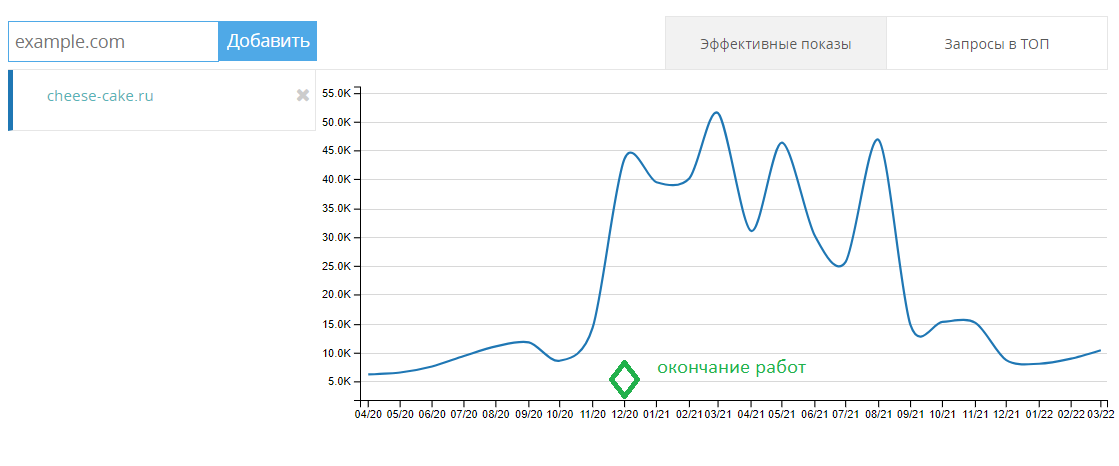
Effective impressions · Cheese Cake
04.2020 — 03.2022
 Explore the chart